 Purple Ruler · Partner storyLeeds · 2026
 Dixons Trinity Chapeltown · Dixons Academies Trust
How to Use Alternative Provision as a Bridge Back to the Classroom
The truest measure of an inclusion room is not how many pupils it keeps. It is how many it can send back. That is an awkward yardstick for a part of education used to being judged by occupancy, but it is the one that has quietly governed two years of work at Dixons Trinity Chapeltown, and it is why the school's story is worth telling now, just as that room is changing shape again.
Dixons Trinity Chapeltown is a secondary in one of Leeds' most challenging communities, and part of Dixons Academies Trust, a 17-school group across the north of England. Like most schools, it found itself with a growing number of pupils who had stopped making it into lessons: some caught in cycles of suspension, many with SEND or social, emotional and mental-health needs, a few too anxious or unwell to sit in a full classroom at all. So it did what good schools do. It opened a room, staffed it, and set out to keep those pupils safe, in the building, and learning.
The harder problem was the teaching. A small, volatile group cannot justify a full-time specialist in every subject, yet those pupils still need real lessons in maths, English and science if they are ever to rejoin their peers. To solve that, the school brought in Purple Ruler, an online alternative-provision and tutoring partner, to deliver live, qualified teaching straight into the room. The arrangement was never meant to be permanent. It was meant to be a bridge.
It began, as it usually does, with behaviour
When the room first opened, it was a behaviour measure. Pupils were being suspended in cycles and drifting out of lessons; the room gave them somewhere to be that was still inside the school day. The early goal was modest and entirely practical: keep them safe, keep them learning, and bring the suspension numbers down.
That much it did. But over two years the school learned something more valuable than whether the room worked. It learned who it worked for, and that lesson is the part most worth passing on.
Who it actually worked for
The pupils who got the most from online provision were not, in the end, those with the most acute behavioural needs. Learning from a screen in a busy room is genuinely hard for a pupil whose difficulties are loudest. The pupils it reached were the quieter cases: those out of school for medical reasons, and those who wanted to learn but, through anxiety, school avoidance or circumstance, could not yet be in a classroom.
One pupil the school describes, anonymised here, had withdrawn from lessons and from almost everyone around her, yet still logged on and worked. She was the proof of the whole idea: not coerced into a room, but choosing, on her own terms, to keep learning. For commissioners weighing the same decision, that is the single most useful takeaway. Online alternative provision is a precision tool, not a catch-all. Match it to the pupil who wants the lesson but cannot reach the room, and it earns its place.
Keeping the teaching real
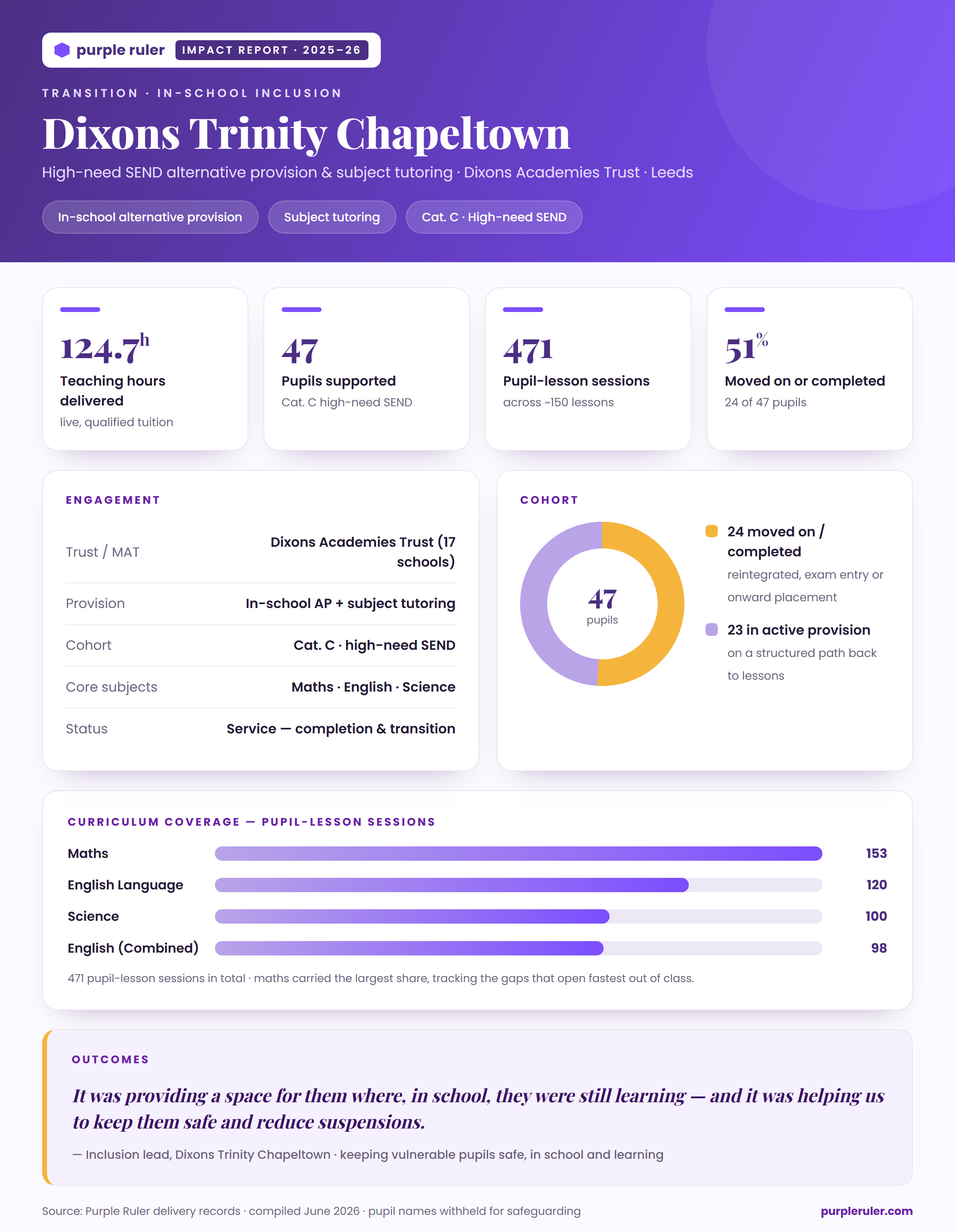
What made the bridge worth crossing was that the lessons were genuine. Across the two years Purple Ruler delivered 124.7 hours of live tuition to 47 pupils, 471 individual pupil-lesson sessions in all, taught by qualified teachers across four core subjects. The balance tells its own story: maths drew the largest share (153 sessions), then English Language (120), science (100) and combined English (98), tracking the gaps that open up fastest when a pupil is away from class.
Dixons is candid that delivering this well takes more than a login. A room full of previously disengaged pupils needs the device locked to the lesson, the audio managed, and a member of staff alongside them. For the most complex cases, the school's own conclusion is worth stating plainly: technology is not a substitute for pastoral support, it sits inside it. None of that is exotic. It is simply the difference, decided in advance, between a calm session and a chaotic one.
The transition
Here is where the room's real purpose shows. Of the 47 pupils it supported, roughly half, 24 of them, have now completed the programme or moved on, while the rest continue on a structured path back towards mainstream routines. Just over half the cohort, in other words, has travelled far enough to step off the bridge. For a group that arrived with attendance and engagement already broken down, that is precisely the outcome the room existed to produce: not retention, but return.
Counted honestly, the provision did four things: it kept vulnerable pupils safe and in school rather than suspended; it re-engaged pupils who had switched off, on their own terms; it kept the curriculum moving in maths, English and science while they were out of class; and, for around half of them, it became the route back.
What the room becomes next
A bridge that works eventually carries most of its traffic, and the most telling sign of success at Dixons is that the room is now changing again. Under a new principal who is a committed advocate for inclusion in lessons, it is being reimagined as a pastoral hub: a daily check-in and check-out for pupils with SEND, with targeted intervention sessions through the day, rather than a full-time learning space. That is not inclusion work ending. It is inclusion work maturing, and online provision stays on hand for the individual pupils who still need it.
For the small number who cannot be on site at all, whether recovering from surgery, severely anxious, or at risk of exclusion, sending work home was never enough. That gap is now covered by Purple Ruler's national online school: a fixed timetable, small groups of six, quality teaching for pupils who cannot reach the building. It is the safety net beneath the bridge, and far cheaper than bespoke home tuition.
Dixons' playbook
The distilled version, what the school would pass on to any other setting or local authority standing up the same kind of provision.
- Name the pupils it's really for.Online provision suits pupils who want the lesson but cannot reach the room, those out for medical reasons, anxious non-attenders, school avoiders, more than the most acute behavioural cases. Decide that before you commission.
- Lead with safety and engagement, not grades.For this cohort the first win is a pupil back in the building, safe, and choosing to learn. Suspensions avoided and attendance held are real results in their own right.
- Buy qualified teaching by the subject.Bring in live, qualified maths, English and science teachers online rather than recruiting a specialist for each into a small room.
- Get the environment right on day one.Lock the device to the lesson, manage the audio, keep an adult alongside, and wrap the technology in pastoral support, not the other way round.
- Plan the return from the first session.Agree per pupil what "moving on" means, whether reintegration, an exam entry or a managed move, and review it so the provision always points back toward mainstream.
- Keep a quality route for those who still can't attend.Have a fixed-timetable online school ready for medical, anxious and at-risk-of-exclusion pupils, so no one is left with worksheets sent home.
- Step it down as it succeeds, and repurpose the space.Plan deliberately for what the room becomes once pupils return, at Dixons a pastoral check-in hub, rather than letting good provision simply stop.
One school, one trust, one wider question
Dixons Trinity Chapeltown is a single school inside a 17-academy trust, and the questions it has worked through are now live across the group, including how to support Year 11 pupils who are not attending with a shared, accessible timetable. That is how a single room becomes a trust strategy. For schools bringing that provision back in-house rather than sending pupils away, the new inclusion-centre playbook shows the same shift at another setting; and for those thinking at federation scale, the White Horse Federation has built a single, trust-wide alternative-provision hub on the same foundations.
© Purple Ruler 2026 · partner story · purpleruler.com